Last Updated: August 2026
Many talented students, graduates, and professionals in Pakistan want to know one thing: can I actually get a job at Google while living in Pakistan? The honest answer is nuanced. Google does not operate a large-scale local hiring program or a dedicated "Google Pakistan" office in the way it does in countries like India, the UAE, or Ireland. That means a Pakistan-based Google job is uncommon, and most opportunities Pakistani applicants pursue are either international roles (requiring relocation and work authorization), select remote-eligible positions, or internship and early-career programs.
This does not mean Google is out of reach. It means you need to understand exactly how Google's hiring works, where the real opportunities are, and how to build the skills and application materials that give you a realistic shot — instead of chasing rumors of a local office or shortcuts that don't exist.
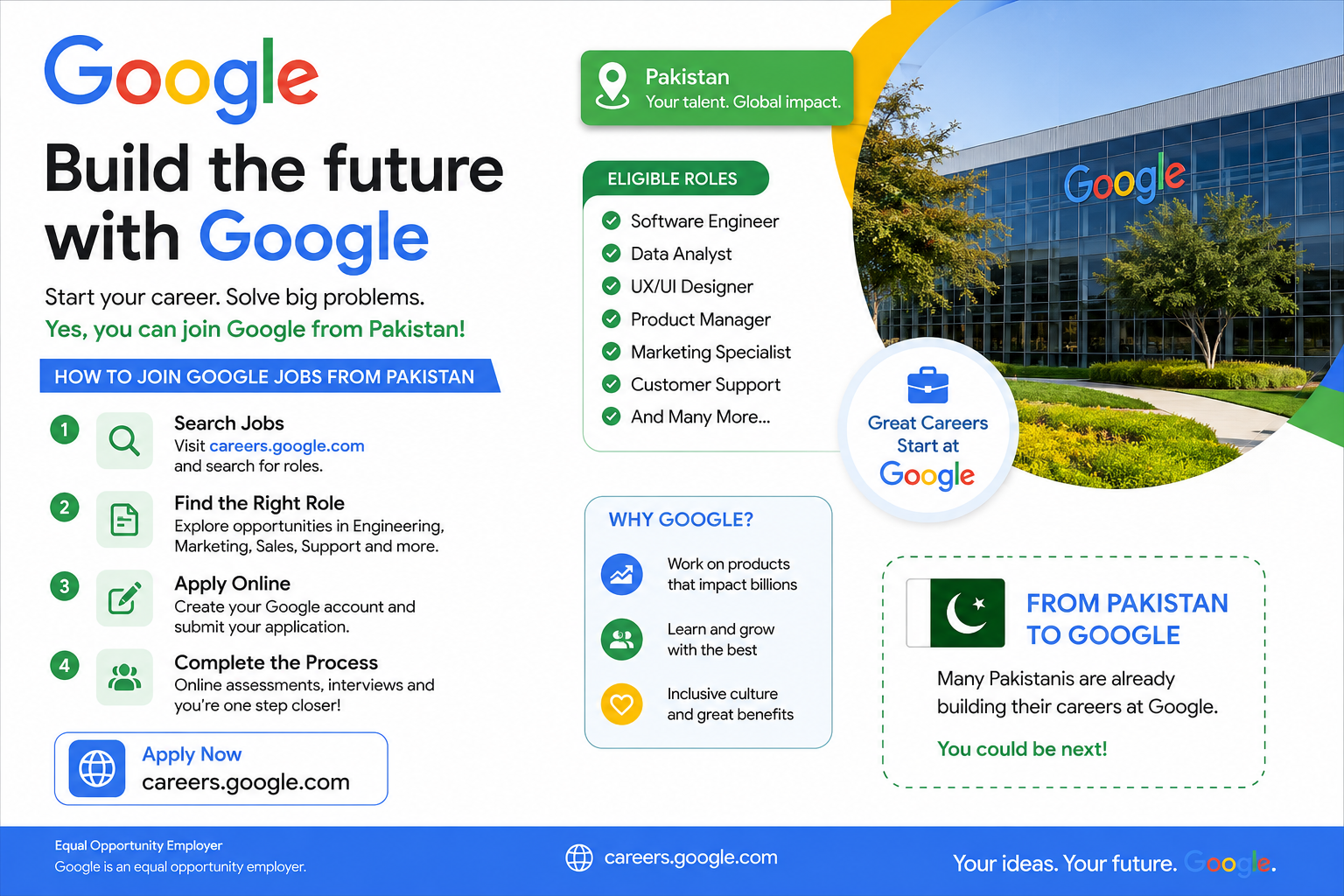
1. Does Google Hire People From Pakistan?
Google's official careers site, Google Careers, lists thousands of open roles at any given time — but the large majority are tied to specific office locations such as the United States, Ireland, India, Singapore, and other countries where Google has established offices. Pakistan is not currently one of Google's core hiring locations, and job listings specifically based in Pakistan are rare to nonexistent.
A few important points to understand:
- Location filters matter. Every job listing specifies a location (or a small set of locations). If a role is listed for "Bengaluru, India" or "Dublin, Ireland," a Pakistan-based applicant generally cannot be hired into that position unless they are eligible and willing to relocate and can secure the required work authorization.
- A job appearing in search results does not mean it's open to everyone. Google Careers is a global platform, so browsing it from Pakistan will show you worldwide listings — but eligibility still depends on the location and requirements written in each individual posting.
- "Remote eligible" is not the same as "remote from anywhere." Some listings are tagged as remote-eligible, but that usually applies to specific countries or regions, not a global remote policy.
The practical takeaway: always read the location and eligibility section of a job posting carefully before assuming you can apply.
2. How to Find Google Jobs
The only reliable place to search for real Google openings is the official Google Careers portal. Here's how to use it effectively:
- Go to the official jobs search page at Google Careers.
- Use the search bar to enter a role or keyword, such as:
- Software Engineer
- Data Analyst
- Data Scientist
- Machine Learning Engineer
- AI Engineer
- Product Manager
- UX Designer
- Technical Program Manager
- Marketing
- Cloud
- Apply the Locations filter to see which countries and cities currently have openings for that keyword. This is the fastest way to confirm whether a role is available in a country you're eligible to work in.
- Open a listing and read it fully. Each posting includes a role summary, minimum qualifications, and preferred qualifications.
- Check the "Minimum qualifications" section first. This is the baseline Google requires — if you don't meet these, the posting is not a realistic fit yet.
- Check the "Preferred qualifications" section. These are not mandatory but strengthen an application.
- Confirm the location and any work-authorization language. Some postings explicitly state that only candidates already authorized to work in a given country will be considered.
3. Google Jobs Pakistani Applicants Can Consider
Google hires across many disciplines. The categories below are commonly relevant to Pakistani applicants with the right skills and eligibility:
- Software Engineering — Building products and infrastructure using languages like Python, Java, C++, and Go; strong fundamentals in data structures and algorithms are essential.
- Artificial Intelligence and Machine Learning — Roles involving model development, applied ML, and AI infrastructure; strong math, statistics, and Python/ML framework skills are valuable.
- Data Science — Analyzing large datasets to guide product and business decisions; SQL, Python/R, and statistical reasoning are core skills.
- Cloud and Infrastructure — Working on Google Cloud products and internal infrastructure; systems knowledge and distributed computing experience matter.
- Cybersecurity — Protecting systems and data; knowledge of security principles, threat analysis, and secure coding practices is useful.
- Product Management — Coordinating between engineering, design, and business teams; strong communication and analytical thinking are key.
- UX/UI and Design — Creating user-centered product experiences; a portfolio demonstrating design thinking is typically expected.
- Sales and Marketing — Supporting Google's advertising and cloud business lines; communication and business acumen are important.
- Technical Support — Helping users and businesses troubleshoot Google products; technical knowledge paired with strong communication skills.
- Business and Operations — Supporting internal processes, program management, and strategy across Google's various teams.
Not every category has openings at every point in time, and availability by location varies constantly — always verify current openings directly on Google Careers.
4. Requirements to Get a Google Job
Requirements vary significantly by role, level, and team, but common themes across most Google postings include:
- Relevant education — Many roles list a bachelor's degree "or equivalent practical experience," meaning strong real-world skills can sometimes substitute for a specific degree.
- Programming skills — For technical roles, proficiency in relevant languages is expected, matched to the specific job.
- Data structures and algorithms — Especially important for software engineering interviews.
- Problem-solving ability — Google evaluates how candidates approach and reason through unfamiliar problems, not just memorized answers.
- Technical projects — Demonstrated, hands-on work (personal projects, open-source contributions, coursework) that shows applied skills.
- Professional experience — Requirements range from entry-level (0-2 years) to senior roles requiring 5+ years, depending on the posting.
- Communication skills — Especially important for product, program management, and customer-facing roles.
- Role-specific knowledge — For example, ML theory for ML roles, or design systems knowledge for UX roles.
- English proficiency — Since most roles operate in English-speaking teams internationally.
- Interview preparation — Google's interview process rewards structured thinking and clear communication under pressure.
Because requirements differ by posting, always treat the specific job description as the source of truth rather than general assumptions.
5. How to Apply for Google Jobs From Pakistan
Follow this process for any Google role you're considering:
- Open Google Careers and create an account if prompted.
- Search for the desired role using relevant keywords.
- Select an appropriate location — filter to countries where you are eligible and willing to work, or check remote-eligible tags carefully.
- Read the full job description, not just the title.
- Check eligibility and work authorization requirements stated in the posting.
- Prepare an ATS-friendly CV/resume tailored to the specific role.
- Prepare relevant projects and a portfolio (GitHub, case studies, design work, etc.) that back up your claimed skills.
- Submit the application directly through the official portal.
- Monitor your application status through your Google Careers account/dashboard.
- Prepare for interviews if you're contacted by a recruiter — don't wait until the last moment.
6. How to Make Your CV Suitable for Google
Google's recruiting teams review a large volume of applications, so clarity and evidence matter more than length or design flair.
- Keep it to one or two pages. Concise, well-organized resumes are easier to scan.
- Quantify achievements wherever possible — numbers make impact concrete.
- List relevant technical skills that match the role, not a generic laundry list.
- Highlight real projects, especially for students and early-career applicants without much professional experience.
- Include GitHub and LinkedIn links if they showcase real, relevant work.
- List certifications only if genuinely relevant to the role you're applying for.
- Describe work experience with outcomes, not just duties.
- Avoid keyword stuffing — listing every buzzword without substance can hurt more than help.
- Never exaggerate skills or experience — technical interviews will expose gaps quickly.
Example — weak bullet point: "Worked on a web application using Python."
Example — stronger, achievement-based bullet point: "Built a Python-based web application that reduced manual data-entry time for 50+ users by automating a previously manual reporting workflow."
The second version shows scope, technology, and measurable impact — exactly what recruiters and hiring managers look for.
7. Google Interview Process
The process varies by role, but commonly includes stages such as:
- Application and recruiter review — Your resume and application are screened for fit against the specific posting.
- Recruiter contact — If shortlisted, a recruiter typically reaches out to discuss the role and next steps.
- Initial interview(s) — Often phone or video-based, focused on core skills relevant to the role.
- Technical or role-specific interviews — For engineering and technical roles, this usually includes coding, algorithms, and sometimes system design; for ML roles, ML fundamentals may be assessed; for non-technical roles, case studies or role-specific scenarios are common.
- Additional interviews — Some roles include multiple rounds with different interviewers or panels.
- Hiring decision — Made after interview feedback is reviewed, which can take time.
Not every candidate goes through an identical sequence — the number and type of interviews depend on the role, level, and team. For technical preparation, focus on coding practice, data structures and algorithms, and (where applicable) system design and machine learning fundamentals. For all roles, practice explaining your past work clearly, since behavioral questions are a standard part of Google's process.
8. Can You Work Remotely for Google From Pakistan?
This is one of the most misunderstood parts of applying to Google from Pakistan.
- Remote availability depends entirely on the specific job posting — there is no blanket "remote from Pakistan" policy.
- "Remote" almost always means remote within a defined country or region, not remote from anywhere in the world.
- Some roles require residence in a specific country due to legal, tax, or operational reasons.
- Work authorization and local employment law compliance affect whether Google can legally employ someone in a given location.
- Always check the location field and any remote-eligibility notes on the specific job listing rather than assuming remote work from Pakistan is possible.
If a posting doesn't explicitly list Pakistan (or "remote — any location") as an eligible location, it's safest to assume you are not eligible to apply from Pakistan for that specific role.
9. Google Internships and Early-Career Opportunities
Google runs internship and early-career programs aimed at students and recent graduates, covering areas like software engineering, product management, UX, and business roles. These programs have their own eligibility rules, application windows, and locations, which change from year to year.
Because these details shift regularly, the best approach is to:
- Check the Students section on Google Careers directly for current programs.
- Note application deadlines carefully, since many programs open and close within specific windows.
- Confirm the program's eligible countries/universities before investing significant time preparing.
10. Skills Pakistani Students Should Learn
Rather than trying to learn everything, focus on the skill set aligned with the specific career path you're targeting.
For software engineering:
- Python, Java, or C++
- Data structures and algorithms
- Git/GitHub
- Databases (SQL)
- System design fundamentals
For AI/ML:
- Python
- NumPy/Pandas
- Machine learning fundamentals
- Deep learning
- SQL
- Statistics
- TensorFlow or PyTorch
- Basic MLOps concepts
For data roles:
- SQL
- Python
- Statistics
- Excel
- Data visualization tools
- Business analysis fundamentals
Depth in one relevant track will usually serve you better in interviews than shallow familiarity with many unrelated tools.
11. How Much Can You Earn at Google?
Compensation at Google depends heavily on the country of employment, the specific role, experience level, seniority level, and the overall total compensation structure (base salary, bonus, and equity where applicable). Because Google does not currently have a defined Pakistan-based hiring structure, there is no official, verifiable Pakistan salary scale to reference.
If you come across salary figures for "Google jobs in Pakistan" on job boards or social media, treat them with caution — many of these are generic estimates, unrelated third-party listings, or unverified sources rather than confirmed Google compensation data. For accurate compensation ranges, rely on the country and role specified in the actual job posting, and treat any online salary estimator figures as approximations, not guarantees.
12. Common Mistakes Pakistani Applicants Should Avoid
- Applying to roles without meeting the minimum qualifications listed.
- Ignoring the location and work-authorization requirements on a posting.
- Sending the same generic CV to every job instead of tailoring it.
- Listing skills without evidence (projects, work samples, or certifications) to back them up.
- Having no meaningful projects to show as an entry-level candidate.
- Including fake or unverifiable certifications.
- Walking into interviews with little to no preparation.
- Applying to only one position and stopping there.
- Paying anyone who claims they can guarantee a Google job.
- Trusting unofficial recruitment emails or websites claiming to represent Google.
13. How to Avoid Google Job Scams
Job scams targeting Pakistani applicants are common, and Google's name is frequently misused by scammers. Protect yourself by watching for:
- Requests for money at any stage of a "hiring process" — legitimate employers do not charge candidates.
- Fake interview invitations sent from unofficial email addresses or messaging apps.
- Fake visa or relocation offers used to pressure quick decisions or payments.
- Requests for banking information before any legitimate hiring stage has been reached.
- Fake recruiters posing as Google employees on LinkedIn or email.
- WhatsApp or Telegram messages claiming to offer guaranteed Google employment — Google does not recruit this way.
The safest way to verify any opportunity is to search for the exact job title directly on the official Google Careers site. If you can't find a matching, currently open listing there, treat the opportunity as unverified.
Conclusion
Getting a job at Google from Pakistan is possible, but it depends far more on matching skills, eligibility, and location requirements than on the company's name alone. Rather than searching for shortcuts or a local office that doesn't currently exist at scale, Pakistani candidates are better served by building strong, verifiable technical or professional skills, creating real projects that demonstrate those skills, preparing a clear and honest CV, and applying only to positions whose location and eligibility requirements they genuinely meet. Treat every opportunity you find outside the official Google Careers portal with skepticism, and let your applications be guided by what a job posting actually says — not by assumptions or rumors.