Germany is one of the most popular destinations in Europe for international skilled workers, and 2026 brings updated rules and salary thresholds that anyone from Pakistan or another non-EU country should understand before applying. But there is no single "Germany work visa" that applies to everyone. Your correct immigration route depends on your education, vocational qualification, work experience, profession, and whether you already have a job offer.
This guide walks through the real routes into German employment for 2026, based on the official Make it in Germany portal (make-it-in-germany.com), the guidance platform run by the German government for international professionals. Where information comes from general guidance rather than an official figure or rule, that distinction is noted clearly. Before applying for anything, the most useful first step is to figure out which route actually fits your situation — not to apply for a generic "work visa" and hope it's the right one.
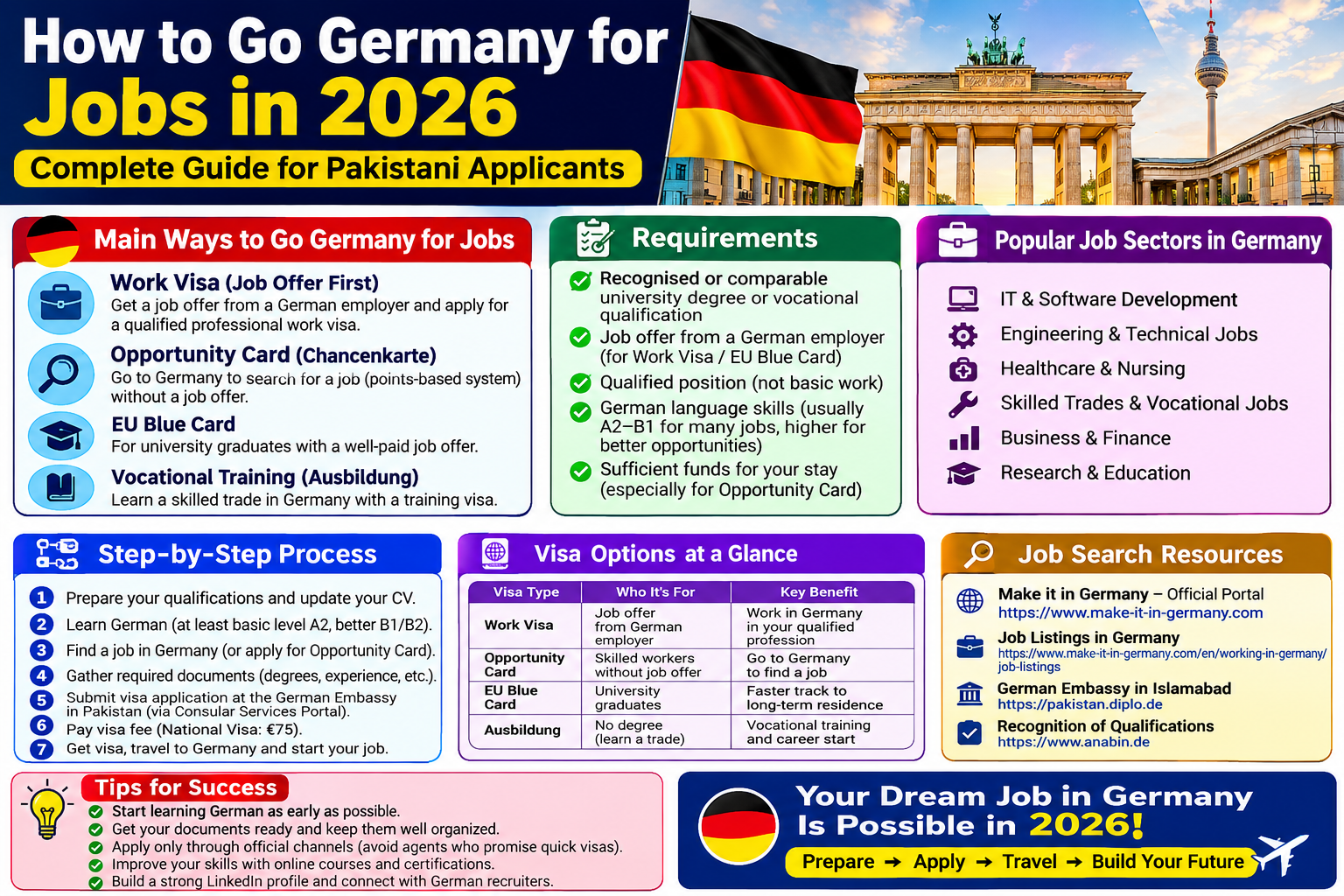
Germany Work Visa 2026 — Quick Overview
| Requirement | General Information |
|---|---|
| Country | Germany |
| Applicants | Non-EU/EEA/Swiss nationals |
| Main purpose | Qualified employment |
| Job offer | Required for many work routes |
| Qualification | Academic or qualified vocational qualification, depending on route |
| Qualification recognition | May be required depending on profession/route |
| Language | Depends on visa/profession |
| Application | German visa/consular process |
| Main official source | Make it in Germany |
Requirements vary significantly by visa category — the table above is a starting orientation, not a checklist for any single route.
Who Can Get a Germany Work Visa?
According to Make it in Germany, applicants with either an academic qualification or qualified vocational training may be eligible for residence permits for qualified employment, provided they meet the applicable requirements for their specific route. A few concepts matter here:
- Recognised or comparable qualification — your degree or vocational training needs to be recognised as equivalent to a German qualification, depending on the route.
- Qualified employment — the job itself generally needs to match your qualification level, not just any available job.
- A German job offer — most routes require a specific, genuine offer from a German employer.
- Regulated vs. non-regulated professions — regulated professions (like many healthcare roles) require a professional licence or formal recognition before you can practise; non-regulated professions have more flexible requirements.
- Recognition of foreign qualifications — this process checks whether your qualification is comparable to a German equivalent, and it varies by profession and country of qualification.
Not every foreign qualification automatically qualifies — recognition and route eligibility depend on your specific profession and documentation.
Step-by-Step: How to Go to Germany for Work in 2026
Step 1: Check Your Eligibility
Before doing anything else, evaluate your own profile against the general factors German immigration routes consider:
- Education and vocational training
- Professional experience
- Profession and whether it's regulated
- Qualification recognition status
- German or English language skills, depending on the role
- Whether you already have a job offer
- Financial requirements, where applicable (particularly relevant for the Opportunity Card)
Use the official Make it in Germany Quick-Check tool to get an initial, personalised sense of which routes might apply to you before making any decisions or spending money on services.
Step 2: Find a Job in Germany
For most work visa routes, a genuine job offer from a German employer is central to the process. This typically involves:
- Building a professional, Germany-style CV and cover letter
- Searching German job portals and employer websites directly
- Looking into international recruitment programs in your field
- Researching skilled-worker shortage areas relevant to your profession
A real job offer takes real effort to secure — no visa route or agency can hand you a guaranteed German job, and you should be skeptical of anyone who claims otherwise.
Step 3: Check Whether Your Qualification Needs Recognition
Qualification recognition is one of the most misunderstood parts of the process:
- Academic qualifications (university degrees) may need to be assessed as comparable to a German degree, depending on the route and profession.
- Vocational qualifications (trade and technical training) can also be assessed for comparability under certain routes.
- Regulated professions — such as many healthcare occupations (doctors, nurses) — generally require formal recognition and, often, a professional licence before you can legally work in that field in Germany.
- Non-regulated professions may not require formal recognition in the same way, but requirements still depend on the specific route you're using.
Recognition requirements are profession- and route-specific — there is no single universal recognition process that applies to everyone.
Step 4: Choose the Correct Visa Route
Option 1: Work Visa for Qualified Professionals
This route is designed for applicants who have completed academic studies or qualified vocational training and meet the relevant requirements for their profession. Key elements include:
- A recognised or comparable qualification
- A specific job offer matching your qualification
- A genuinely qualified position (not unskilled work)
- A professional licence, where the profession requires one
- Meeting any additional applicable approval requirements
Option 2: EU Blue Card
The EU Blue Card is a residence permit for qualified professionals with a specific job offer meeting defined salary thresholds. For 2026:
- General minimum gross annual salary: €50,700
- Lower threshold for eligible shortage occupations: €45,934.20
- Young professionals who obtained their last qualification less than three years ago may also qualify at €45,934.20, subject to the applicable requirements
The EU Blue Card carries additional eligibility requirements beyond salary alone — it is not a standard work visa available to every applicant, and meeting the salary threshold does not by itself guarantee eligibility.
Option 3: Visa for Professionally Experienced Workers
This route is aimed at eligible applicants with professional experience who want to work in a non-regulated profession. Formal German recognition of qualifications may not always be required under this specific route, but applicants must still satisfy the applicable requirements for it. This is not simply "a work visa without a degree" — it has its own defined conditions.
Option 4: Opportunity Card (Chancenkarte)
The Opportunity Card is not simply a "Germany work visa" — it's fundamentally a job-search route. It allows eligible applicants to come to Germany to search for suitable employment or a qualification measure, under its own rules. Key features:
- A recognised qualification route and a points-system route are both available paths to eligibility
- A financial resources requirement to show you can support yourself during the job-search period — for 2026, this is €1,091 net per month, demonstrated through a blocked account or other accepted means
- A defined job-search period
- Part-time work up to 20 hours per week is allowed while searching
- Once you find suitable employment, you may move to an appropriate residence title for actual work
The Opportunity Card is not mandatory for everyone hoping to work in Germany — eligible applicants can also search for jobs from their home country and apply for a work-specific route directly if they secure an offer first.
Step 5: Prepare Your Documents
The exact list depends on your visa category and the German mission responsible for your application, but commonly requested documents include:
- Valid passport
- Employment contract or job offer letter
- Updated CV
- Educational certificates
- Vocational qualification documents, where relevant
- Recognition or comparability documents, where required
- Professional licence, where required
- Proof of language skills, where applicable
- Proof of financial resources, where required (e.g. for the Opportunity Card)
- Health insurance documentation, where applicable
- Completed visa application forms
- Passport photographs, where required
Always confirm the exact list with the specific German mission handling your application, since requirements can differ by visa category and location.
Step 6: Apply for the German Visa
- Determine the correct visa category for your situation.
- Check the specific requirements for that category.
- Prepare all required documents.
- Complete the appropriate application form.
- Submit your application through the responsible German mission or official online process, where available.
- Attend any required appointment or biometric process.
- Pay the applicable visa fee.
- Wait for processing, and respond promptly to any requests for additional documents.
- Receive the visa decision.
Use the official German Foreign Office and consular process for your application — not unofficial agents who claim they can speed things up or guarantee outcomes.
Step 7: Travel to Germany
Once your visa is approved, there are still administrative steps ahead:
- Entering Germany within your visa's validity
- Registering your residence (Anmeldung) where required
- Obtaining the appropriate residence permit for your situation
- Starting your employment under the terms of your approved route
- Arranging health insurance
- Completing other required administrative registrations
Processing times and exact procedures vary by case and location — there is no fixed, universal timeline that applies to every applicant.
Germany Work Visa Requirements for Pakistani Applicants
Pakistani citizens are third-country nationals under German immigration law, meaning the standard non-EU application process applies. In practice, this generally involves:
- Identifying the correct route based on your qualification and job situation
- Securing a job offer where your chosen route requires one
- Completing any necessary qualification recognition
- Choosing the correct visa category
- Preparing the required documents
- Applying through the German mission responsible for Pakistan, or the applicable official online process
- Attending any required biometric appointment or interview
There is no confirmed, officially guaranteed special pathway exclusively for Pakistani applicants beyond the standard routes described here — if one existed, it would be published on Make it in Germany or an official German government source.
Can You Go to Germany Without a Job Offer?
It depends on the route:
- Many regular work visa routes require a specific job offer before you apply.
- The Opportunity Card provides an alternative for eligible applicants who want to search for employment after arriving in Germany.
- The Opportunity Card has its own eligibility criteria and financial requirements — it is not open to everyone regardless of background.
Determine which route actually applies to your circumstances before assuming you need — or don't need — a job offer in hand.
Can You Get a Germany Work Visa Without a University Degree?
Yes, in certain circumstances — a university degree is not always required. Relevant routes include:
- Pathways based on qualified vocational training rather than academic study
- The visa for professionally experienced workers, for eligible non-regulated professions
- Certain skilled-worker routes that recognise trade and technical qualifications
That said, this doesn't mean anyone can get a Germany work visa without a degree — eligibility still depends on your specific qualification, profession, and whether recognition is required for that profession.
Germany Work Visa Salary Requirements in 2026
Salary requirements are not universal — they depend entirely on the visa route:
- EU Blue Card: €50,700 gross annual salary generally; €45,934.20 for eligible shortage occupations; €45,934.20 for eligible young professionals under the applicable rules
- Opportunity Card: not an employment salary requirement at all — instead, a financial resources requirement of €1,091 net per month to support yourself during the job search
- Other work visa routes: salary and financial requirements vary by category and are not covered by a single universal figure
There is no single "minimum Germany work visa salary" that applies across every route — always check the specific threshold for the route you're pursuing.
Germany Work Visa vs Opportunity Card vs EU Blue Card
| Feature | Work Visa for Qualified Professionals | EU Blue Card | Opportunity Card |
|---|---|---|---|
| Main purpose | Employment | Qualified employment | Job search |
| Job offer | Generally required | Required | Not necessarily |
| Qualification | Academic/vocational depending on route | Specific qualification requirements | Qualification/points requirements |
| Salary threshold | Route-dependent | Specific threshold (€50,700 / €45,934.20) | Not a normal employment salary route |
| Job searching after entry | Not the primary purpose | Not the primary purpose | Main purpose |
| Part-time job search work | Not applicable | Depends on residence title | Up to 20 hours/week under the applicable rules |
Common Mistakes to Avoid
- Applying for the wrong visa category for your situation
- Trying to use a tourist visa to work — this does not give you the right to take up employment
- Ignoring qualification recognition requirements for your profession
- Submitting false or altered documents
- Paying scammers who claim they can guarantee a visa or job
- Using unverified "agents" instead of official channels
- Applying for jobs that don't actually match the requirements of your intended route
- Skipping verification with the official German mission
- Assuming every job offer automatically qualifies for immigration purposes
- Assuming the Opportunity Card is a full-time work visa, rather than a job-search route
Important: entering Germany on a short-stay Schengen tourist visa does not automatically give you the right to take up employment. Working while on a tourist visa is not a legitimate route into the German labour market.
Germany Work Visa Scams
Be alert to these common warning signs:
- Nobody can legitimately guarantee visa approval. Immigration decisions are made by German authorities based on your documents and eligibility — not by any agent or company.
- Nobody should guarantee a German job in exchange for a large upfront payment. Legitimate recruitment doesn't work this way.
- Verify employers independently before paying any fees or sharing sensitive documents.
- Use official German government sources — Make it in Germany, the Federal Foreign Office, and the responsible German mission — rather than third-party agents claiming special access.
- Avoid fake appointment sellers and unofficial "visa agents" who claim they can jump the queue.
- Never submit false documents — this can result in permanent bans from applying for German visas in the future.
Frequently Asked Questions
How can I get a Germany work visa in 2026? It depends on your qualification, job offer, and profession — use the official Make it in Germany Quick-Check to identify your route.
Can I apply for a Germany work visa from Pakistan? Yes, through the German mission responsible for visa applications in Pakistan.
Do I need a job offer? For most routes, yes. The Opportunity Card is the main exception.
Can I work in Germany without a university degree? Yes, in some cases, through vocational or professionally-experienced-worker routes.
What is the Opportunity Card? A job-search route, not a standard work visa — it lets eligible applicants search for employment in Germany, with part-time work allowed up to 20 hours per week.
What is the EU Blue Card? A residence permit for qualified professionals with a specific job offer meeting defined salary thresholds.
How much salary is required for the EU Blue Card in 2026? €50,700 generally, or €45,934.20 for eligible shortage occupations and young professionals.
Do I need German language skills? Depends on the visa route and specific job.
Do I need to get my qualification recognised? Depends on your profession and route — regulated professions typically require it.
Can I go to Germany without a job offer? Yes, via the Opportunity Card, subject to its own eligibility and financial requirements.
Can I work on a tourist visa? No — this is not a legitimate route into the German labour market.
Where should I apply for the German work visa? Through the German mission responsible for your location, or the applicable official online process.
Final Conclusion
Germany offers several real immigration pathways for qualified international workers, but there is no single "Germany work visa" that fits every applicant. Your correct route depends on your education, vocational qualification, work experience, profession, job offer status, and other individual factors. Before applying for anything, use the official Make it in Germany Quick-Check and consult official German visa information to understand which route genuinely applies to you. No guide, agent, or service — including this one — can promise you visa approval or guaranteed employment; treat any such promise as a red flag.
Official Resources
- Make it in Germany — https://www.make-it-in-germany.com/en/
- German Federal Foreign Office — https://www.auswaertiges-amt.de/en
- Germany Visa Navigator — https://visa-navigator.diplo.de/
Always verify current requirements, salary thresholds, and application procedures directly through these official sources before making any decisions or payments.